
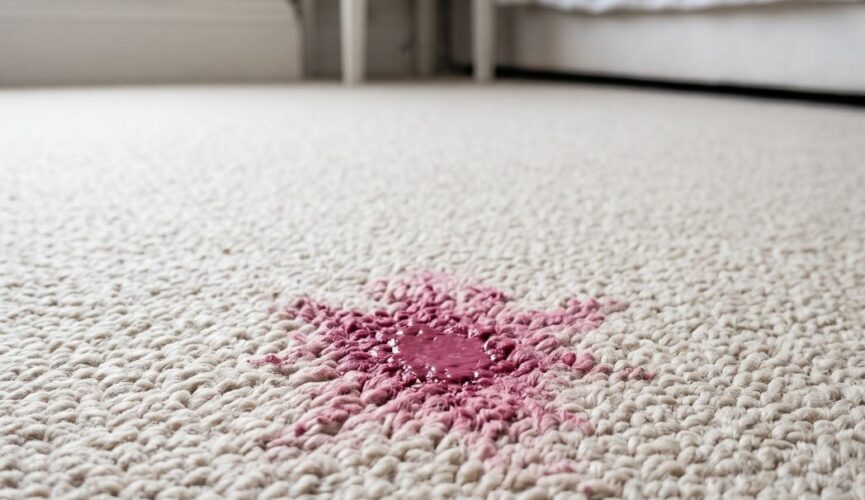
A full bottle of nail varnish holds about fifteen millilitres. That is a tablespoon. Tipped onto a wool twist beside a bed, it lands as a mark roughly the size of a side plate – and by the time the person who spilled it has finished trying to help, I am looking at something closer to a dinner tray, three shades of pink deep in the pile, and a wet halo where the solvent has run out along the fibres.
The spreading is the whole problem. The varnish itself is a small, containable thing for about ninety seconds.
Why does nail varnish spread the moment you touch it?
Nail varnish is not a stain in the way tea or red wine is a stain. It is a lacquer. Nitrocellulose resin, a plasticiser to stop it going brittle, pigment held in suspension, and a fast-flashing solvent blend – usually ethyl acetate and butyl acetate – whose only job is to evaporate and leave the film behind. On a nail, that film sets in a couple of minutes. On carpet it does the same thing, except the surface it sets against is thousands of individual fibres with air between them.
For the first minute or so, the spill sits high. Surface tension and the density of the pile hold most of the volume on the top third of the yarn, which is why a fresh spill often looks alarming but shallow. Press a cloth into it and you do two things at once: you push liquid varnish down towards the backing, and you smear the pigment sideways across fibres that were clean. Both are permanent moves. The lacquer that reaches the primary backing is out of reach of anything a homeowner owns.
What the film is doing in the first two minutes
The film skins over from the top down. Underneath the skin, the varnish is still mobile and still carrying pigment. Rubbing breaks the skin and releases what is underneath into fibre that had escaped. This is the mechanism behind almost every ruined nail varnish job I attend – the spill was small and the response was energetic.
I would rather a client did nothing at all for twenty minutes and rang me than reached for the nearest cloth. That is not a sales line. A dried spill on the tips of the yarn is a job I can often take back to nothing. A wet spill that has been worked into the backing with a flannel is a patch replacement.
What should you do in the first ten minutes?
Get the loose volume off before it soaks. A spoon works. So does a butter knife or a stiff piece of card held at a shallow angle, scooping towards the centre of the spill rather than dragging outwards. What you are after is the pooled varnish sitting proud of the pile, and nothing else. Do not chase what has already gone down.
Then blot – and blot properly, which means little and often rather than one hard press. White kitchen roll or a white cotton cloth, laid flat, allowed to take up what it will, lifted straight up, folded to a clean face, laid down again. Ten light contacts beat two heavy ones. The moment a cloth face is coloured, it is a distribution tool, so change it.
Colour matters more than people expect. Anything with dye in it – kitchen roll with a printed pattern, coloured flannels and the corner of a bath towel – will hand its own colour over to wet carpet under solvent. White only, every time.
Working from the outside in
Start at the clean edge of the spill and move towards the middle. Every pass should end nearer the centre than it began. Carpet cleaning is full of this instruction because it is the only reliable way to keep a mark’s diameter fixed while you reduce its density. Work centre-outwards and the mark grows with every stroke, which is how a spill the size of a two-pound coin becomes a spill the size of a beer mat.
Blot little and often, keep the contact area small, and accept that you are not finishing the job. You are containing it. There is a stage, usually about six or seven blots in, where the cloth stops lifting much and the carpet still looks bad. That is the stage to stop. Anything past it is friction, and friction on wet lacquer is what fuzzes the yarn tips and leaves a permanently dull, roughened patch even after the colour has gone.
A flat in one of the mansion blocks off Westow Hill in Crystal Palace, late last year: a burgundy varnish on an oatmeal wool loop, spilled at about eleven at night. She had the sense to scrape it, blot it with a white pillowcase, and then leave it alone until the morning. Six blots. I got the whole thing out with solvent and a bonnet in under half an hour, and the only reason that was possible is that ninety per cent of the pigment was still sitting where it landed, in the top of the pile, dry and brittle by the time I arrived.
Is nail varnish remover safe to use on a carpet?
Here is the opinion that loses me arguments with clients: acetone-free remover is the worst thing you can put on a carpet, and considerably worse than plain acetone. The acetone-free products replace the aggressive solvent with a milder ester and then load in glycerine, lanolin, fragrance and – on the sweet-smelling ones – a dye of their own. The mild solvent softens the varnish without lifting it, so you get spreading. The oils stay in the pile and turn into a greasy magnet that greys up within a fortnight. And the dye is a second stain arriving to help the first.
Straight acetone at least does what it claims. It dissolves nitrocellulose fast and leaves nothing behind. The risks are real and worth naming. Acetone destroys acetate and triacetate fibres outright – rare in carpet, common in older rugs and in some viscose blends. It can soften the latex adhesive holding a tufted carpet’s backings together, which is what produces the crisp, ruined feel of a delaminated patch. On solution-dyed polypropylene it is usually harmless. On nylon it can pull the dye. Wool tolerates it better than most people assume, but strips of lanolin and repeated flooding will leave the patch feeling like straw.
The trouble with “acetone-free”
Test first, in a wardrobe or under a sofa, and give it twenty minutes before you judge the result. Apply to the cloth rather than the carpet. A damp corner of white cotton, pressed and lifted, little and often – never poured, never scrubbed. Pouring puts solvent through to the backing, and once the backing has dissolved varnish in it, the mark reappears every time the carpet is cleaned for the rest of its life.
Gel polish is a separate animal. It does not cure without a UV or LED lamp, so a spilled gel stays tacky for days and picks up every fibre and hair that touches it. Acetone works on it, slowly, with dwell time. Do not expect the fast collapse you get with ordinary varnish.
What happens when the spill has already dried?
Dried varnish is easier, not harder. The film has locked the pigment into a brittle sheet sitting on the yarn tips, and brittle sheets can be broken and lifted rather than dissolved and carried.
Hold an ice pack over it for ten minutes, in a bag so no water gets in. Cold makes the plasticiser stiff and the film shatters instead of stretching. Then work it with a blunt edge – the back of a teaspoon, a plastic scraper – tapping and flaking rather than digging. Vacuum up the flakes as you go, or you will grind them back in with your knees. A good percentage of a dried spill comes away as dust before any solvent is involved.
When trimming beats treating
Sometimes the honest answer is scissors. If the varnish is confined to the top few millimetres of a cut pile and the carpet is a mid-tone or a heather rather than a flat pale colour, careful trimming with nail scissors, a few strands at a time, held at slightly different heights so no shelf forms, will beat any chemical approach. It takes twenty minutes and it does not risk the backing.
I did this in a bedroom in Pinner on a dense saxony where the alternative was flooding a wool carpet with acetone six inches from a skirting board. It is invisible now. On loop pile, do not touch it – cutting a loop starts a run.
Why do the pink marks come back a day later?
Wicking. Anything that went down towards the backing during the incident is still there, and as the area dries, moisture travels up the fibres by capillary action and brings dissolved pigment with it. The carpet looks clean at four in the afternoon and has a soft pink ghost by breakfast.
This is why over-applying solvent is such a bad idea, and why professional work on varnish uses controlled dwell and extraction rather than volume.
Weighting and drying
Once the treatment is done, pile a folded stack of white towels over the damp patch and put something heavy on top – a stack of books, a box. Leave it for four or five hours. The towels give the rising moisture somewhere to go that is not the surface of your carpet. Change them once if they colour.
If pink returns after all that, it is a dye stain rather than a resin stain, and the reds in varnish are lake pigments that respond to reduction rather than solvent. That is a heat and chemistry job with a proper stain kit, and it is not something to attempt with supermarket products.
The bottle that caused all this is still under the bed, on its side, with the brush half out.