
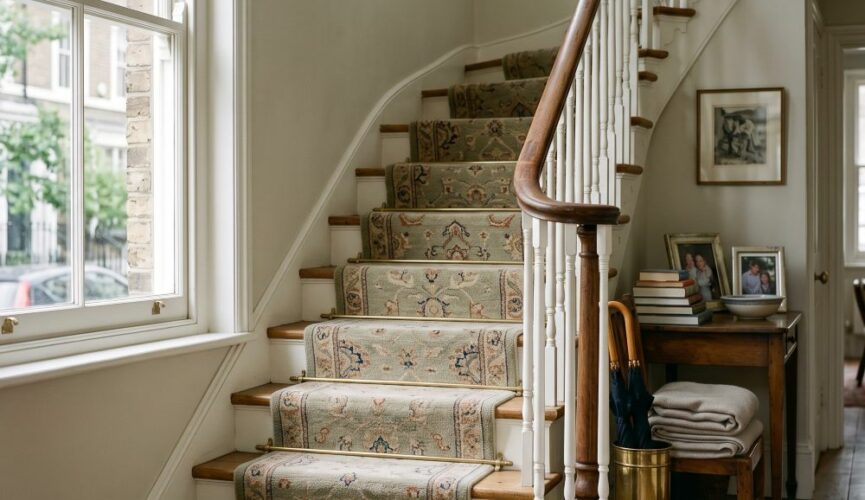
A staircase is the worst-designed object in the house from a cleaning point of view. Every horizontal surface has a vertical one attached to it, water runs downhill, the whole thing is made of timber that has been in place since about 1890, and the person cleaning it is working one-handed at an awkward angle with their knees on the step below.
It is also the dirtiest textile in most houses by a distance, because every journey between floors crosses it.
Why is water the main risk on a staircase?
On a flat floor, over-wetting is a drying problem. On stairs it is a damage problem, and the damage happens somewhere you cannot see.
Water applied to a tread does not stay on the tread. It runs to the nose, follows the front edge down, and collects in the joint where the nose meets the riser below – a joint that in a Victorian house is usually a butt joint with a hundred and thirty years of movement in it. From there it goes into end grain. Timber takes up moisture through end grain at many times the rate it does through a face, so a small amount of water at that joint travels further into the stair than the same amount spilled in the middle of a landing.
Three things follow. Old glue blocks under the treads soften and the stair develops a creak it did not have. Carpet tacks and gripper pins rust, and rust bleeds up through wool as an orange dot that appears a week later and does not come out. And any paint or varnish under the runner lifts at the edges, which nobody notices until the runner comes up years later.
What happens at the nose and the riser joint
There is a related failure that shows up faster. Underlay on stairs is usually cut in pads that sit on the tread and stop short of the nose, so a saturated pad holds water against bare timber with a carpet on top of it and no airflow whatsoever. It can take four days to dry. In that time you get the smell, and on a jute-backed runner you can get a brown tide line along the nose that requires its own treatment afterwards.
The rule I work to is that no part of a staircase should be wetter, at any moment, than a wrung-out cloth.
How much of the job is dry work?
Most of it, and this is where domestic attempts go wrong before any liquid is involved. A stair runner in a family house holds an extraordinary quantity of dry soil – grit from shoes, sand from the front path, hair, and the fine dust that settles out of a stairwell because a staircase acts as a chimney for air moving between floors.
Wetting that soil turns it into mud and drives it into the base of the pile. Every minute spent on dry removal first pays back twice.
Work tread by tread with a proper upright or a cylinder with a powered head, and give each tread two passes in opposite directions rather than one long sweep down the flight. Then go back with a crevice tool along both sides of the runner where it meets the string, and along the base of every riser. That junction collects more than the middle of the tread and gets vacuumed least.
The crevice tool and the nose edge
The nose takes about eighty per cent of the footfall on a staircase. It is where the pile is crushed flattest, and crushed pile releases soil badly, so it wants attention that a flat vacuum pass does not give it. A stiff brush – a horsehair upholstery brush, not a wire one – drawn along the nose lifts the yarn and brings embedded grit to the surface where suction can take it. Do the brushing first, then vacuum.
I did a flight in a terrace off Albion Road in Stoke Newington where the dry stage took forty minutes on fourteen treads and filled the machine twice. The client had vacuumed the stairs the previous evening. She stood watching the second emptying with an expression I have seen a lot.
What is the right way to apply moisture, tread by tread?
Small volumes, high recovery, and one tread finished before the next one starts. The hand tool for this is an upholstery head, not a wand and not a hire machine’s floor tool – something with a narrow mouth and a good seal that you can hold at the angle the stair demands.
Pre-spray from a hand sprayer or a small pump-up, applied to the pile as a mist rather than a soak. Give it five to eight minutes of dwell, and do not let it dry on the fibre. For a wool runner the chemistry should be mildly acidic; the alkaline traffic-lane pre-sprays that work on nylon office carpet will yellow wool and leave residue that re-soils within weeks.
Then extract with the tool held so its mouth runs down the slope of the nose, and follow every wet pass with two dry ones. That two-to-one ratio is the difference between a runner that is damp for two hours and one that is damp overnight. On the riser, work upwards from the tread below so the tool is pulling moisture away from the joint rather than pushing it into it.
Move down the flight, not up. Start at the top and back away from your own work, or you will be kneeling on cleaned wet carpet for the entire job and pressing the moisture you just removed back into the pad.
Prespray, dwell, and the two-to-one rule
Towel the nose after every three or four treads. A folded white towel, pressed hard along the front edge with the flat of the hand, takes out the water that gravity has already delivered there and stops the tide line forming. Skip this and the flight will show a line along every nose when it dries, evenly spaced, unmistakable.
Which runners should never be wet-cleaned at all?
Sisal, seagrass, coir and jute. Natural plant-fibre runners are common in London houses now and they mark permanently with plain water – a single drip leaves a ring that dries darker at the edge and never fades. These get dry compound cleaning, worked in with a brush and vacuumed out, and nothing else. Any cleaner who offers to extract a sisal stair runner should be shown out.
Wool-sisal blends sit in between and get judged tread by tread – the wool takes moisture happily and the plant fibre beside it does not, so a blend runner with heavy soiling on the lower flight is often better handled with a compound throughout than with two methods on one staircase.
Old hand-woven runners with unstable dyes are the other category, and the test is thirty seconds with a damp white cloth on an inconspicuous section near the top. If colour transfers, the job is a specialist wash off-site with the runner lifted.
Sisal, seagrass and stair rods
Rods come off first, always. Unscrew the brackets, lay the rods on a dust sheet, and clean the brass or the antique finish separately with the appropriate product – water and metal polish on a rod that stays in place will run straight into the runner beneath it and produce a green-black mark on wool that is close to permanent.
Tacked runners need a check for movement before you start. A runner that has loosened at the tacks will shift under a hand tool, and a shifted runner on a stair is a fall waiting to happen.
How do you dry a flight properly, and how long should it take?
Airflow up the stairwell, and use the chimney effect that made the runner dirty in the first place. An air mover at the bottom of the flight angled up the treads, a window open at the top, and the warm air rising does most of the work. Two air movers on a straight flight will have a correctly cleaned wool runner touch-dry in two to three hours.
A dogleg with a half-landing is harder, because the turn kills the airflow and the winder treads at the corner are the ones that took the most water on the way through. Point a second mover at the winders directly and check them by hand before you sign the job off. They will be the last part of the flight to dry every time.
Without airflow, and with the door at the bottom closed, the same flight can take a day. A stairwell in a mid-terrace has poor natural ventilation and high humidity, and moisture that cannot leave the air will not leave the carpet.
Keep everyone off it. This is not optional and it is where the real risk in the job sits – a damp wool runner on a polished timber tread has almost no grip, and the people most likely to use the stairs during the drying window are children and whoever in the house is least steady. Rope it off and mean it.
The opinion that costs me bookings
Here it is: if a wool stair runner is more than about eight years old and worn through at the noses, cleaning it is the wrong purchase. Have it lifted and shifted. A runner cut with three or four inches of tuck at the top and bottom can be moved up or down by the depth of one tread, which puts fresh pile at every nose and pushes the worn sections onto the flat where nobody looks. A carpet fitter will do it in an hour or two for less than most cleaning quotes, and the result is a runner that looks new rather than clean.
I have suggested this in houses where I then did no work at all. A place in Barnes with a dark green Wilton runner had four inches of tuck under the top step and nobody had touched it in twenty years.
The rods went back on that one in the wrong order and the client rang me about it a fortnight later.