
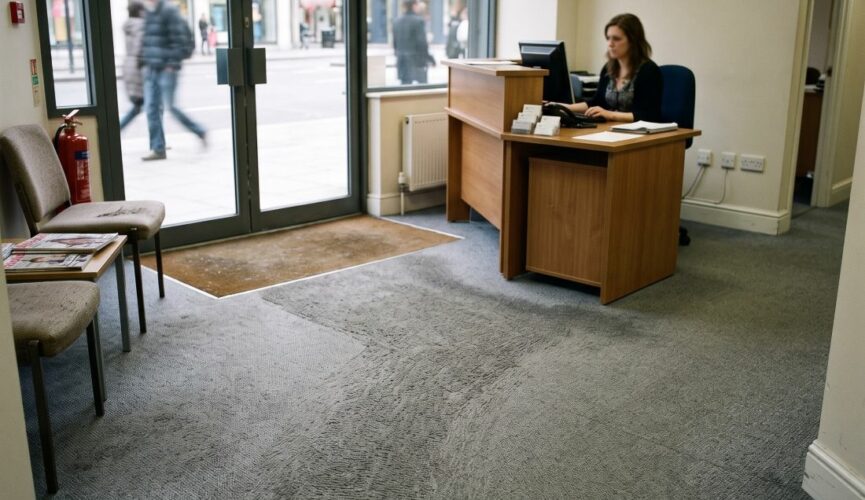
Nobody replaces a reception carpet because it has worn through. They replace it because it looks tired next to the rest of the floor, and there is a specific point – usually somewhere between the third and fifth year – where a facilities manager stands by the lift and sees it for the first time properly. The carpet at the far end of the room is fine. The carpet by the doors is flattened, and reflecting light like brushed metal.
That contrast is the whole problem, and almost all of it is created in the first three metres.
What is doing the damage in a reception carpet?
Grit. Not spills, not coffee, not the occasional biro – dry particulate soil, tracked in on shoes, most of it mineral, much of it sharper under a microscope than anything else that will ever touch the fibre. London street soil is a mix of quartz dust, brake residue, tyre rubber and whatever the pavement outside contributes, and it behaves like a very fine abrasive powder.
Every footfall grinds that powder against the sides of the yarn. The fibre does not break; it scuffs. Thousands of microscopic scratches change the way each filament reflects light, and a carpet whose fibres scatter light instead of reflecting it cleanly reads as dull and dirty even when it has been cleaned to the base of the pile. This is why a reception carpet can come up perfectly clean on extraction and still look worse than the corridor behind it.
Add pile crush on top. Traffic compresses the yarn, the twist relaxes, the tips splay open, and the carpet loses the upright structure that made it look uniform. Crushing and abrasion arrive together and reinforce each other, because a splayed fibre presents more surface to the grit.
Grit, and why wear is optical
The practical consequence is that soil removal is a structural maintenance activity, not a cosmetic one. Every day the grit stays in the pile is a day it spends filing away at the fibre under the weight of everyone walking over it. Once the optical damage is there, no cleaning process reverses it – you are looking at a permanently duller carpet in that zone for the rest of its life.
Which reframes the argument about vacuuming budgets, and I will come back to it.
Why do the first three metres take everything?
Because that is where the soil comes off. A shoe carries a finite load and sheds the great majority of it within a few paces of entering the building. By the time a visitor reaches the desk, their soles are close to clean, and everything they were carrying is now in the carpet behind them.
There is a second mechanism at that end of the room, and it does more damage per square metre than the walking does. People turn. At the door they pivot to hold it, at the reception desk they pivot to face the lifts, at the lift lobby they pivot to press the button and again to step in. A pivoting shoe applies torsion, and torsion tears fibre out of the yarn in a way straight-line walking does not. Look at any worn reception and you will find the bald patches are circular, sitting at exactly those points.
A building on Great Sutton Street in Clerkenwell had a reception carpet that told the whole story from the doorway. Mid-grey loop, five years old, immaculate across two-thirds of the floor and destroyed in three circles: one inside the entrance, one in front of the visitor book, one at the lift call panel. The manager wanted the whole floor replaced. What it needed was three tiles lifted and swapped with three from behind the sofas, which took me forty minutes and bought them another three years.
The pivot point
Rain multiplies everything. A wet sole holds far more soil than a dry one and releases it further into the building, so a rainy fortnight in February pushes the damage zone deeper than the first three metres and into the part of the floor nobody has protected. It also carries dissolved road salt in winter, which crystallises in the pile and adds another abrasive to the mix.
How much matting does a London entrance need?
More than it has. The general guidance in the trade is around six metres of walk-off matting to capture the bulk of what comes in on shoes, and I have never surveyed a London office reception that had it. Two metres is normal. A polite little mat at the threshold, the length of one stride, is common and does approximately nothing – a shoe needs to strike the same surface several times to give up its load, and one stride gives it one contact per foot.
The matting also needs to do two different jobs. An external scraper section – rubber or open grid – knocks off the coarse grit before the door. An internal absorbent section takes the moisture and the fine particulate, and it needs to be a textile that holds water rather than a rubber-backed mat that lets it pool and then transfers it to the next pair of shoes.
Scraper zone and absorbent zone
Get the sequence right and the carpet behind it lasts years longer. Get it wrong – absorbent matting outside, saturated by the weather, and nothing to scrape with – and the matting becomes a soil reservoir that loads shoes rather than cleaning them.
Rental mats swapped weekly work if the swap frequency matches the footfall. A distribution office in Croydon I look after has theirs changed twice a week in winter and once in summer, and the carpet inside it has outlasted two identical floors in the same building.
Which specification survives, and which is a vanity?
Here is the unpopular part. Specifying a pale, plain, low-density carpet for a London reception is a design decision that costs the tenant a replacement cycle, and the architect who drew it will be long gone by the time anybody pays for it. Every reception I have seen in a soft pale grey plain loop has looked past its best within thirty months. The same building with a mid-tone flecked or subtly patterned carpet gets seven or eight years out of the same footfall.
Density is the specification that matters most and gets discussed least. A dense, tightly constructed carpet keeps grit at the surface where a vacuum can reach it; an open, low-density one lets soil fall to the backing where nothing removes it and where it grinds against the yarn base. Face weight on its own tells you little. Ask about tufts per square metre and pile height together.
On fibre, solution-dyed nylon is the workhorse and deserves to be. The colour runs through the filament rather than sitting on it, so abrasion does not expose pale undyed cores, and it tolerates aggressive cleaning. Polypropylene is cheaper and crushes early. Wool in a high-traffic reception is a lovely thing for about two years.
Tiles and the swap
Tiles are the single best decision available for a reception, for one reason: you can rotate them. Lift the ruined tiles at the pivot points, move them to a corner behind the seating, and bring the corner tiles forward. It costs nothing, it is reversible, and if the original order included ten per cent attic stock – which it should have – the floor can be maintained indefinitely.
Broadloom in a reception commits you to replacing the whole floor when one square metre fails. That is the trade-off, and it rarely gets weighed at specification stage.
Two more things eat reception carpet and neither is footfall. Desk chair castors cut a channel behind a reception counter faster than a hundred visitors a day cut the approach to it, and a hard chair mat costs less than a tile. And glass frontage fades the carpet in a band parallel to the window, which on a solution-dyed nylon takes years and on a piece-dyed wool takes months – the replacement then has to match a floor that has already shifted colour.
What maintenance schedule slows the wear?
Daily vacuuming, with a machine that has a brush bar. This is the opinion that costs me work and I will defend it anyway: for a reception carpet, a proper daily vacuum is worth more than any deep clean I can sell you. Extraction removes what is already bound in. Vacuuming removes grit before it has had a chance to do its filing, which is the only intervention that acts on the cause.
The machine matters. A tub vacuum with a suction-only floor tool pulls loose surface litter and leaves the embedded grit exactly where it is, and most contract cleaning specifications in London buy exactly that machine because it is quicker across a large floor. An upright with mechanical agitation, taken over the entrance zone in two directions, gets a multiple of the soil out.
Why the machine matters more than the rota
Specify the machine in the cleaning contract, in writing, and check it. Contract cleaning is priced by the hour and the equipment on site drifts towards whatever is fastest unless somebody names it. I have walked into buildings where the specification said brush-agitation upright and the cupboard held three tub vacuums and a bag of dust bags for a machine that left two years ago.
Then zone the schedule. The entrance zone wants daily attention and a restorative clean two or three times a year; the static seating area might need one clean annually. Cleaning the whole floor to the same frequency wastes budget at one end and under-serves the other.
Interim encapsulation between deep cleans keeps traffic lanes acceptable and buys time in a building that cannot take a wet floor during office hours. It has a place. It does not substitute for the vacuum.
The three swapped tiles in Clerkenwell are still there, behind the sofa, with their circular bald patches facing the wall.