
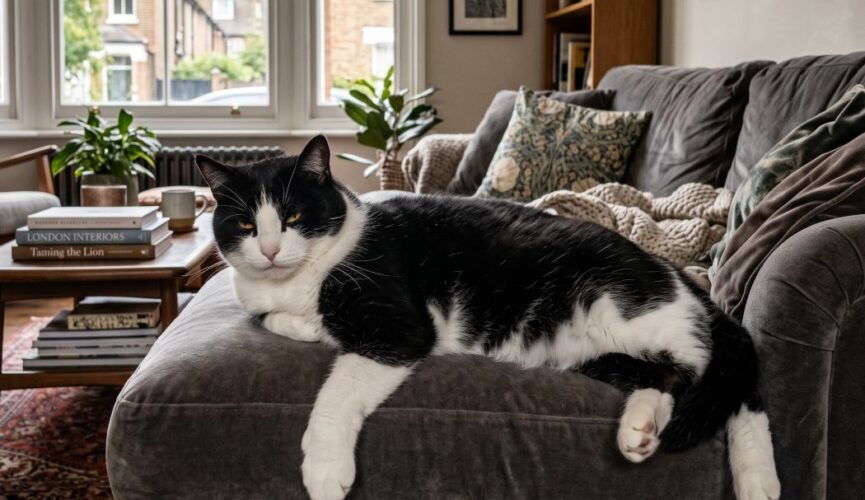
There is a smell that empties a room, and an unneutered tom marking a corner of a lounge produces it. Householders describe it as ammonia, which is close but not the whole story, and the reason ordinary cleaning fails on it is that the part of the smell you can wash out is a fraction of what has been left behind.
The rest arrives later. That is the difficulty with this job – you clean, the flat smells fine for a fortnight, and then a wet week in October brings it all back.
Why does tom spray smell worse than ordinary cat urine?
Spray is not the same fluid as a puddle by the litter tray. A tom backing up against a wall with a quivering tail delivers a small volume of urine mixed with secretions from the anal glands, and that mixture carries compounds an ordinary squat urination does not.
The important one is felinine, an amino acid that entire males produce in quantity and that is close to odourless when it lands. Bacteria on the surface break it down over days and weeks into sulphur compounds – thiols, chemically related to what a skunk uses – and thiols are detectable by the human nose at concentrations that barely register as present. This is why a fresh spray often smells mild and a three-month-old spray is unbearable. The stink is manufactured in place, slowly, from a deposit that was never especially smelly to begin with.
Alongside that, you have the urine itself: urea and uric acid, which forms crystalline salts that do not dissolve in plain water. The urea washes out easily. The salts sit in the fibre and the backing, waiting.
The chemistry that keeps releasing
Understand this and the pattern of complaints makes sense. Sooner or later the deposit rehydrates – summer humidity, a damp autumn, a carpet cleaned with too much water – and rehydrated salts release ammonia and the sulphur compounds go volatile again. The smell has a season.
I have had clients convinced the cat had come back in through a window and sprayed again. It had not. The same six-month-old deposit was releasing for the third time.
Why does the smell come back after a normal carpet clean?
Because a normal carpet clean is designed to lift soil out of the top of the pile, and spray does not live there. It lives in the base of the yarn, in the primary and secondary backings, in the underlay, and frequently in the floorboards beneath. A hot water extraction pass takes out the water-soluble fraction and leaves the rest in place, damper than it was.
Heat makes it worse. Protein and heat is a bad combination – the same reason you rinse a bloodstain in cold water – and a steam cleaner run over cat spray will bond residue to fibre in a way that no subsequent treatment fully reverses. Every domestic steam mop sold on the promise of sanitising a carpet is a liability in a house with a marking tom.
Ammonia-based household cleaners are the other trap. They smell to a cat like urine does, which reads as another animal’s mark, which invites remarking on the same spot. I have seen a hallway corner in a Victorian conversion that had been sprayed, cleaned with a supermarket ammonia product, sprayed again, and cleaned again, weekly, for the best part of a year.
Humidity, and the crystals nobody removed
There is a timing point in all this that people resist hearing. An intact tom will keep marking, and no treatment outruns a cat that is still doing it. Neutering reduces the behaviour in the large majority of males, and the sooner it happens the better the odds, though a cat that has been marking for years may carry on out of habit long after the hormones have gone. Clean the flat before the vet’s appointment and you are paying for a job that starts undoing itself the same afternoon.
The test for whether a job has been done properly is a wet week. Anyone can make a room smell acceptable on the day, with airflow and a bit of fragrance in the rinse. Come back in November and open the door.
How do you find every deposit before you treat anything?
Turn the lights off and use a UV torch. Dried urine fluoresces a dull yellow-green under 365nm and you will find deposits nobody knew existed, in places that make no sense until you remember what the cat was doing. Spray goes on vertical surfaces. Skirting boards, the sides of sofas, curtain hems, the backs of doors, the corner of a bookcase at cat height – it lands high and runs down, and the carpet only catches the run-off.
A ground-floor flat off Bushey Hill Road in Camberwell taught me to do this every time. The tenant had two toms and the smell in the front room was ferocious, but the carpet under UV showed only a couple of modest marks. The wall behind the radiator was covered. Fifteen or twenty separate deposits, some of them a foot up the plaster, all of them running down behind the pipes to a skirting board that had been quietly absorbing it for two years. Cleaning that carpet alone would have achieved nothing at all, and I said so before I quoted.
Mark what you find with masking tape while the lights are off. In daylight the marks vanish and your memory of where they were is worse than you think.
UV torch and the vertical line
Look for the line. A marking cat produces a horizontal band of deposits at a consistent height along a run of wall or furniture, and once you have spotted the band you can predict where the rest of it is. The band tells you which room the cat considered contested, which is usually the one with a window facing a rival’s territory.
One more place to check: the return air path. Marking near a door that stays shut concentrates the smell in a way that convinces people the source is somewhere else entirely, and I have pulled up carpet in the middle of a room on a client’s insistence, found nothing, and located the deposits behind a bedroom door eight feet away.
Which products work on it, and which make things worse?
Enzyme cleaners work, on the condition that they are used in a way almost nobody uses them. An enzyme is a catalyst and it needs three things to do its job: moisture, time, and a temperature that is warm rather than hot. A spritz from a trigger bottle that dries in twenty minutes has done essentially nothing.
Apply generously – as much volume as the original deposit, and then more, because the deposit spread as it soaked. Then cover the area with a sheet of cling film or a damp towel and leave it for eight hours or overnight. The covering stops evaporation and keeps the enzymes in solution and working. This single step is the difference between a product that works and the same product in the bin marked useless.
Hydrogen peroxide has a place on the sulphur compounds, which oxidise readily, but it will lift colour from a wool carpet and from many dyed nylons, so it is a test-first material and not one for a dark rug. White vinegar has a following online and it does neutralise the alkaline salts to a degree, but it is a holding measure rather than a treatment, and the acid does nothing whatever to the sulphur chemistry that produces the worst of the smell. Bicarbonate of soda absorbs a little and does nothing to the crystals. Scented pet-odour sprays add fragrance to thiols and produce something worse than either.
Dwell time is the whole trick
Sooner or later somebody will tell you they tried an enzyme product and it did not work. Ask how long they left it on. The answer is nearly always a number of minutes.
When is the carpet not the problem at all?
Often. This is the part of the conversation clients least want to have, and my view is that saying it early is the only defensible way to work: where spray has been going into the same corner for months, cleaning the carpet without lifting it is money burnt. The underlay is a sponge. Foam underlay holds contamination at a volume the carpet above it cannot match, and no extraction from the surface pulls it back through.
A maisonette in Hanwell ran this in reverse and it cost the owner twice. The carpet was replaced first, at some expense, over an underlay and a floor nobody had inspected, and the new carpet smelled within a month. Sooner or later the contamination underneath finds its way up through whatever you lay on top of it.
Lift the carpet in that corner. It is usually a small area, it usually goes back down without a fitter, and what you find underneath tells you whether the job is a clean or a small piece of joinery. Wet underlay comes out and gets replaced – it costs very little and it is the single highest-value thing you can do.
Then look at the boards. Timber absorbs, and a floorboard that has taken cat spray for a year will keep releasing through any new underlay you put over it. Scrub it, let it dry properly, then seal it with a shellac-based stain-blocking primer. Two coats, taken up the skirting.
Sealing the boards
Concrete behaves the same way, more slowly, and takes the same treatment. Screed under a damp-proof membrane is usually fine; older solid floors without one are not.
The cat, in Camberwell, was booked in for neutering the week I finished. His brother was not, and I went back the following spring.